|

CLICK: Central tenet of NY's earliest laws - Governors Island's legacy of substance - to be honored by NY Mayor Bill de Blasio:
appeals to Commission on Public Ethics and NAMING of Open Green Space for NYS's birthright
CLICK: New York: Beacon of Tolerance - By Amala Levine, Editor of HaShiur, NY's Central Synagogue - 2 pages
CLICK: Birth years of New York State and New York City, Governor Cuomo, Mayor Bloomberg -11 Pages
Preserve the Jurisprudence of Tolerance
— New York State's Birthright The New World's first lawful expression
of religious tolerance ("Toleration") took place in 1624 on Governors Island in New York State. That jurisprudence was the basis for religious and ethnic diversity and applied to the region that is now referred to as
the New York Tri-State. Tolerance is Liberty's antecedent because Liberty can't thrive in an intolerant culture. They are
the fraternal twins in the conception of American Freedom because, in its pure form, the principle of
Tolerance is inclusive and doesn't know a privileged religion, preferred ethnicity or superior race. This was affirmed in
the Bill of Rights of the U.S. Constitution which outlawed primacy of religion and race thus making all religions, ethnicities
and races equal and free. Fourteen years before that First Amendment promise of Toleration without preference
in 1791—at the time no guarantee for all citizens—the judicial right to Toleration
was already enshrined in New York State's first constitution of 1777 in confirmation of its juridical delivery in
1624 and New York's polyglot culture ever since: "XXXVIII. And whereas we are required ...to guard against that spiritual oppression and intolerance...,
this convention..., in the name and by the authority of the good people of this State, ordain, determine, and declare, that
the free exercise and enjoyment of religious profession and worship, without discrimination or preference, shall forever hereafter
be allowed, within this State, to all mankind.... It also made the union of religion and
politics unconstitutional: XXXIX. And...no
minister of the gospel, or priest of any denomination whatsoever, shall, at any time hereafter, under any presence or description
whatever, be eligible to, or capable of holding, any civil or military office or place within this State." The United States of America came together as a secular nation with the
pledge that "Congress shall make no law respecting an establishment of religion, or prohibiting
the free exercise thereof." Yet, Governors Island's legacy of the year 1624 and New York State's birthright became only
available to all U.S. citizens in 1868 upon a Bill of Rights amendment which displaced individual state rights
in religious matters and rendered the 1791 First Amendment effective thus. Therefore,
as of that year, 1868, citizens of the secular United States were also afforded freedom
from religion and religious submission or compulsion. Namely, religious commandments and strictures
became subordinate to the primacy of secular law which now set the limits of citizens' liberties. In April 2003, Walter Cronkite wrote: “The Foundation’s
concept for the conversion of Governors Island provides a moral, philosophic and patriotic base that should considerably augment
the argument to keep that invaluable heritage in the public domain.”
Composing a triad of America's
fundamental values as National Symbols in New York Harbor—Tolerance, Liberty and Welcome as embodied by Governors Island,
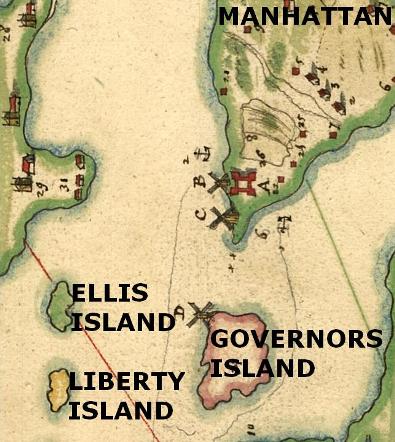
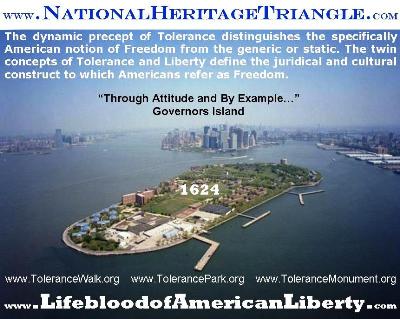
Liberty Island and Ellis Island—by recognizing each island’s unique facet of history: the “National Heritage Triangle” as an allegory of harmonious virtues.
The magnitude of the emblematic value of Governors Island as
the nation’s oldest natural historic symbol is based on one’s deeper understanding of three critical historical
events: the three primary European landings and settlements on the North American East coast which led to the formation of
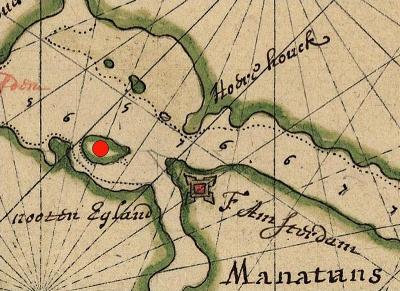
the Original Thirteen. They were: Jamestown, Virginia, 1607; New Plymouth, New England, 1620; and Nooten Eyland, New Netherland, 1624 (now Governors Island, New York). In the discussions of "What to do with
Governors Island?", all pertinent officials and nearly all legislators have denied—through silence from 1997
through 2009—the island's 1624 historic legacy which shaped and became part of our national identity (similar to express historical unconsciousness of the Holocaust but
having distinct opposite effects, i. e., a new beginning with spiritual rebirth through freedom of conscience in religion
versus deportation into an abyss pending death through ethnic/religious hatred.) Yet, the Governors Island landing/settlement was the best planned, the most successful one and by far the most important
one of the three because it was on the place on which the New World's first juridical expression of religious tolerance took
place. As the locus of the political-cultural conception of freedom of conscience in religion—the basis of pluralism
and individual freedom (= liberty) in North America—Governors Island signifies the origin of religious freedom through
the jurisprudence of toleration (= religious tolerance). That Tolerance, as America’s ultimate value and dynamic
precept, precedes Liberty. It is vital in defining and defending the often generic or static notion of [personal] American
freedom. Tolerance and Liberty can both be recognized visually as equal or conjoined partners in the conception of American
Freedom. We envisage doing that on the officially recognized 1624 birthplace of New York State because that place—Governors
Island—connotes the womb of New York State’s historic legacy and cultural identity of diversity through Tolerance—New
York's gift to the nation. (For historical quotes of the official instructions to the Jamestown and Governors
Island settlers go to page three of the ARTICLE below: “Governors
Island, Lifeblood of American Liberty.)" ********************************************************************* •
Is the UNITED STATES interested in protecting and preserving its national heritage of historic substance and of profound thematic
meaning to AMERICAN freedom? Will it embrace and endorse the Governors
Island Preservation and Education
Project aimed at perpetuating the memory of a place and a history that
is of the utmost importance to humanity, that may help extinguish the fires of intolerance and be remembered as a symbol of
hope to the country, if not the world? Is it ready to accept the Tolerance Monument as the universal embodiment of the dynamic force of tolerance?
• Can NEW YORK STATE, or the New York Tri-State region, provide leadership in safeguarding its seventeenth-century
geo-political legacy of toleration as precursor to its 1777 Constitution and the 1791 First
Amendment in the Bill of Rights—culturally enduring but temporarily lost for a century by an English
Act of Parliament that outlawed the Roman Catholic faith in 1691—by actively reinstating the nation's oldest natural,
historic and cultural monument and turning it into an asset of 21st-century relevance? • Will NEW YORK CITY be generous enough to integrate the State's
most important landmark and yet unexploited national cultural asset—Governors Island—into contemporary community
life, and so achieve a greater shared knowledge about the nation's past, strengthen the Tri-State's identity of tolerance
as the lifeblood of American liberty, fortify New York's civic pride, and drive New York's artistic and economic vitality
(sign PETITION)? ********************************************************************* New York’s legal and political tradition of tolerance, the basis for its characteristic cultural diversity
and pluralism, had its beginnings on Governors Island. That tolerance is central to the contemporary American conception of freedom which can be defined in terms of the twin credos of tolerance
and liberty. Its origin as an ethical force in the Western Hemisphere and as a legal and political imperative can be traced
to the year 1624, in what is now the State of New York. (For third-party video CLICK on YouTube). Tolerance is an active dynamic entailing reciprocity and reciprocal respect.
Always bilaterally demanding, it forges “American” freedom by relentlessly transforming plurality into constructive
pluralism as a never-finished product of American culture. Tolerance
defines and gives meaning to an otherwise undemanding “generic” or “static” freedom. It is the indispensable
dynamic component in American freedom and Western civilization. Without conscious vigilance and broad awareness of that vital,
fundamental notion of tolerance, there will be times when there will be no freedom in the sense that Americans recognize that
term today. Left unnurtured and unprotected, simple liberty invites and facilitates the "friends"
of intolerance and extremism—complacency, carelessness, apathy, passivity and insipidness—foretelling looming disaster or opening the door to insidious assaults on civil liberties with voices in the name of disingenious slogans like "freedom" or rhetoric like "American values." A proposed Governors Island Tolerance Park will halt historical amnesia and restore Governors Island to its rightful historical importance by preserving its historic
message of universal value that lies at the root of American liberty. Thus,
the park will provide our children with an opportunity to understand the meaning of American freedom. It will afford them
a deeper appreciation of tolerance and liberty as equal partners in a pluralist society, at the very place where these notions
first took root in 1624. Tolerance builds
liberty. Intolerance kills liberty. The Park will therefore preserve Governors Island's historic symbolism, be
an enduring beacon for humanity and extol America's vital role in advancing liberty through the moral force of tolerance.
ARTICLE: Juridical Source of Freedom of Conscience and Religious Tolerance ("Toleration") - a 2009 quadricentennial contribution
by Joep de Koning
ARTICLE: Governors Island - Lifeblood of American Liberty. Commemorating full residency of Ashkenazim AND Sephardim in New
York in 1655 - Jewish instrumentality in New World trade and settlement (by Joep de Koning - affirmed in E. Kritzler's 2008
book.)
ARTICLE: First Amendment Right of the People to Petition the Government for a Redress of Grievances - 1649 (by Joep de Koning)
ARTICLE: The years of birth of New York City - originally named New Amsterdam in 1625 - and the sovereignty of New York State
in 1624 - originally the juridical entity of New Netherland (by Leo Hershkowitz and Joep de Koning)
|
CLICK: Vital political affirmation for the unifying Common Theme that is indispensable to Religious and Racial Equality and
in understanding the notion of American Freedom - 1 page
CLICK: Upholding the Flag of Liberty? - The POPE and Nobel Prize winners: BARACK OBAMA and JIMMY CARTER, 4 pages
CLICK: Endorsement request for the message of Tolerance from presidential candidate MITT ROMNEY versus presidential candidate
BARACK OBAMA
Protect the Reciprocal Dynamic of Tolerance — the Foundational Principle for American Liberty
Diversity fosters tolerance as a pragmatic
result out of necessity (in trade-based urban centers for instance.) However, broad awareness of the precept of Tolerance
as precursor to liberty-for-all and as a reciprocal dynamic in the notion of American Freedom would expose the iniquities
of intolerance. It would help to coexist peacefully by furthering successful pluralism/diversity across the land.
Tolerance is the complement of intolerance. Tolerance therefore can't be sloth or indifference as neither is intolerance.
Tolerance must be pro-active in the defense of American liberty. Only through conscious vigilance will it drive out intolerance
- the forces of inequality, bigotry and discrimination - which insidiously attacks liberty and undermines the norms and values
of the United States as a secular, liberalist democracy. As a universal value from which Liberty sprouts, the principle
of Tolerance extends the boundaries of Liberty for all mankind through eternal consciousness and vigilance through an ICONIC
STRUCTURE. The ideal notion of Tolerance being selective (i.e.,
excluding any one group and thus not pertaining to all groups), therefore, is incongruous. The Tolerance precept - a two-way street
- is America's ultimate virtue. It bears no relation to the verb 'to tolerate' - a one-way street. Intolerance divides - Tolerance
unites!
In a secular country like the U.S. (with no official, preferred or state religion) the perpetuation of its
liberalist democracy - in which the ethic of liberty-for-all is culturally revered and racial and religious liberty are constitutionally
protected - is not served by intolerance, religious injunctions and/or compulsion. As religions have gained special treatment
under the U.S. tax code, some also try to receive preferential treatment by having civil laws supplanted by religious ones
as if separation of State and Church is of no concern. Often they are successful in receiving privileged political treatment
and exemptions from civil policy and laws because of various politicians' pursuit of their self-interest and disrespect for
or willful ignorance of the U.S. Constitution (e.g., explicitly ignoring allegations of child sex abuse in a political deal
between a cleric and a district attorney, click here, or, for instance, implicitly condoning child sex abuse by some clergy members through
political lethargy in reverence of religious power and commandments thus disregarding public policy and the rule of law -
click here.) Furthermore, certain religions, ethnicities and races have not adjusted yet to
the welcome they received from America or are unwilling to know and understand America's ethos as rooted in its liberalist
democratic culture. Newly imported faiths from monistic cultures where state and religion are one and the same or which don't
always consider and allow the validity, freedom and equality of other ethnicities or religions (e.g., by executing converts)
or don't always accept people of differing consciences (infidels), teach their adherents the gospel of intolerance. They would
have to accept the notion, and adjust accordingly that when in the U.S., under the U.S. Constitution, supremacy of a religion
or race is forbidden since 1868 and 1865 respectively. The secular state thus protects the rights of its citizens - including
minors/innocents - which must be upheld by civil authorities and cannot be delegated to religious authorities. Unless religious
organizations and their devotees understand that religious identity is not identical to religious spirituality and are taught,
officially, to live according to the dynamic principle of tolerance as the foundation of American liberty
- i.e., by demanding change in some of their religion's rules, traditions or antediluvian practices and behavior (e.g., polygamy,
ritual female circumcision of minors and honor killings, or denying employees of faiths-based, state-subsidized institutions direct access to federally-mandated contraception services) - their insular, intolerant or ignorant conduct may become a severe problem in America in the future: Some groups may fail
to coexist successfully or peacefully according to America's democratic values (e.g., by rejecting equality/liberty of the
sexes or races) or, alternatively, these fundamental American values may become obscured or cease to exist altogether by condoning
intolerance and by political complacency or appeasement. In his Chapel Hill Commencement Address
of May 13, 2012, New York City Mayor Michael Bloomberg proclaimed that "If government can deny freedom to one, it
can deny freedom to all...More than any other generation that has walked the earth, you are free to pursue your dreams - unbounded
by limits placed on your race, gender, ethnicity, orientation or lineage...Exclusion and equality are mortal enemies - and
in America, every time they have met in battle, equality has ultimately triumphed...I have no doubt that in your lifetime,
liberty's light will allow us to see more clearly the truth of our nation's founding principles, and allow us to see all people,
and all couples, as full and equal members of the American family." In his Inaugural Address of January 1,
2011, Governor Andrew M. Cuomo said that "Only the people's voice can silence the calls of the special interests
in the halls of the Capitol...In truth the partnership between the Executive and the Legislature has not been working well
for years and that must change...The potential [real] power of the Governor is to mobilize the people of the State of
New York." In his State of the State Address of January 5, 2011, he proclaimed: "We currently have
a government of dysfunction, gridlock and corruption - we have to transform it into a government of performance, integrity and pride...The New York State Legislature is the best legislature historically in the nation, the most talented people, that's, that's
who we are...We want a government that puts the people first and not the special interests first." On
June 6, 2009, President Barack H. Obama said: "As we face down the hardships and struggles of our time and arrive
at that hour for which we were born, we cannot help but draw strength from those moments in history when the best among us
were somehow able to swallow their fears and secure a beachhead on an unforgiving shore." In his Inaugural Address of March 17, 2008, Governor
David A. Paterson proclaimed: "Let us put personal politics, party advantage and power struggles aside, in favor
of service, in the interests of the people...Let me introduce myself...I am the governor of New York State."
Earlier,
at the January 1, 2007, Inaugural Address, Governor Eliot Spitzer declared “New York created the model
for the kind of society that would be duplicated throughout the country and around the globe: Our state was born as an island
at the center of the world (Governors Island).” (For 34-slide presentation in pdf
CLICK Governors Island Legacy, New York's Identity.)
Governors
Island, Nooten Eyland (in pidgin language Nutten Island) until 1784, is the place of origin of American tolerance as the basis
for cultural diversity and pluralism and, as such, it embodies a Message of Profound National Importance. Therefore,
the island’s cultural and national heritage has outstanding universal value which could qualify it as a potential
World Heritage Site.
Together
with liberty, the notion of tolerance serves to define the cultural and juridical construct to which American personal freedom
refers. In the face of intolerance, tolerance is a vigilant dynamic — it is neither uncritical acceptance, complacency,
appeasement or submission, nor laxity, sloth or indifference.
Embedded in Governors Island—New York
State’s legally recognized, historic birthplace—tolerance is the quintessence of New York’s cultural patrimony
since 1624 (CLICK HERE for Legislative Resolutions 5476 and 2708 which recognize this heritage).
With the arrival of the first
settlers to the New York Tri-State region on Governors Island in 1624, the legal and cultural traditions of the Low Lands,
including the basic human virtue and jurisprudence of toleration (= religious tolerance) as the basis for ethnic diversity,
were first implanted by law upon North American soil (unlike the first landings in New England and Virginia). This plurality, for instance, was recorded in a census of 1639 and portrayed on a Manhattan map which shows a
large farm owned by America’s first Muslim planter, Antoni du Turck, a Moroccan from Fez. After sixty years as New Netherland
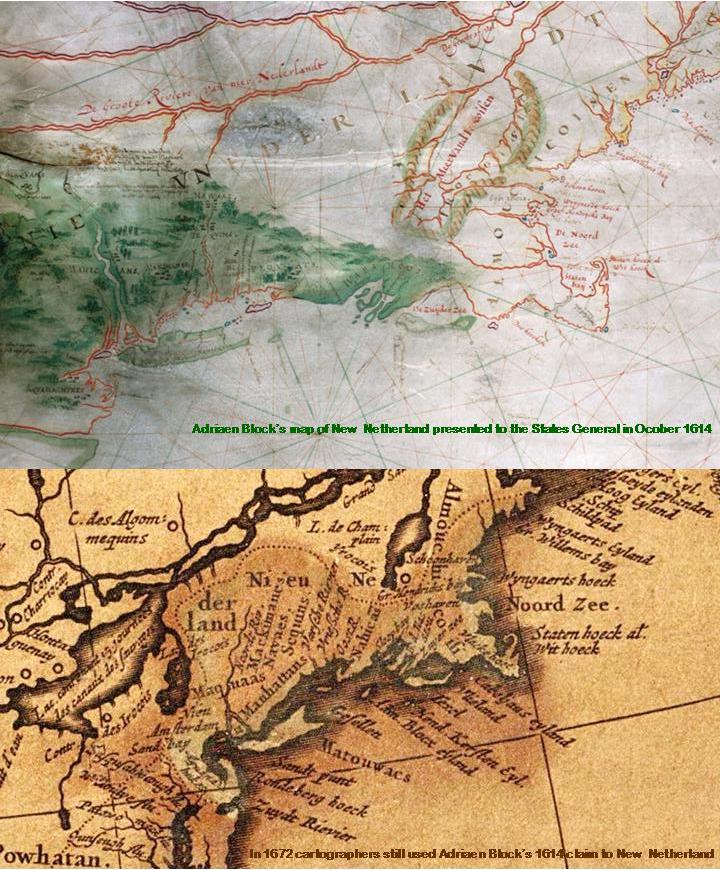
(1614-1674), the region – now the New York Tri-State area – came under definitive English authority.
The virtuous conception of tolerance, thus introduced in the Western Hemisphere and rooted in New York State’s very
birth in the year 1624, can be considered New York’s first and unique contribution to American culture. Governors
Island is therefore the nation's oldest natural symbol of primary value. Its message is America's ultimate virtue.
One hundred fifty two years later, in 1776, New York’s birthfather’s
fundamental precept of political freedom (and with regard to individual freedoms, in 1791, by way of the First Amendment)
was to become the crucial underpinning of the American Republic with the adoption of the "Right-of-Man-Doctrine"
that formed the basis for the statement that "The United Colonies are, and of Right ought to be Free and Independent
States."
That doctrine stated, in 1776, that "whenever any form of government (the English Crown) becomes
destructive of these ends, it is the right of the people to alter or to abolish it and to institute new government."
One hundred ninety five years prior to that Declaration of Independence, in 1581, the same doctrine was the basis
for the United States of the Netherlands when it stated that "when a ruler of the people (King Philip II of Spain) does
not behave thus, but on the contrary oppresses them...they may not only disallow his authority, but legally proceed to the
choice of another ruler for their defense."
It was therefore no happenstance that John Adams wrote, in 1781,
that "the originals of the two republics are so much alike that the history of one seems but a transcript from that of
the other...the great characters the Dutch Republic exhibits...have been particularly studied, admired and imitated in EVERY
American state." Later Adams wrote: "I modestly blush for my nation when I consider the low estimation in which
we have held the importance of the [Netherlands] connections with us. Their separation from England, union with France and
Spain and their treaty with us was THE EVENT which ultimately turned the scale of the American Revolutionary war and produced
the peace in 1783."
The analogous republics—the United States of America and the United States of the
Netherlands—were not coincidental. The latter’s DNA and precepts, implanted on Governors Island in the year 1624
and the building block of America’s earliest childhood, were responsible for the traits that shaped America's like-minded
personality and deeply felt commitment to political freedom and individual liberty.
The right to rebel against
tyranny, the right to seek redress of grievances and freedom in religion and of the press, all can be traced to the New York
Tri-State region when it was known as New Netherland with New Amsterdam (now New York City) at its center.
In summary, Governors Island—as the place of first settlement between 38 and 42 degrees latitude,
sandwiched between Virginia and New England, and as the legally recognized birthplace of New York State on which the jurisprudence of
toleration (= religious tolerance) as a precept in the conception of American freedom was planted in 1624—is a historical
archeological landmark of 21st-century thematic relevance and enduring value to future generations.
For the above mentioned reasons, the island is a natural historic National Symbol while representing
the uniquely-shared Mutual Heritage of two nations.
PLEASE FORWARD THIS SITE AND,
WHERE APPROPRIATE, PROVIDE US WITH A LINK ON YOUR WEBSITE TO
|
|
In order legally to dedicate 50 acres or 30 percent of Governors Island to
the Tolerance Park for the benefit of future generations, State and City politicians would need to • Accept and understand the meaning of New York State's thematic patrimony to America.
(It started with the entrance of the East Indian Company ship Half Moon into what is now named New York harbor on September
11, 1609, as the precursor event for the introduction of America’s first and only republican, non-royalist, legal-cultural
tradition in the year 1624); • acknowledge the delivery onto Governors
Island of New York State's jurisprudence of toleration (= religious tolerance) in the year 1624 as the source of American
pluralism—a legacy that endured culturally and
which was codified as an individual right in New York State's Constitution of 1777, and as a national promise in an amendment
to the U.S. Constitution through the Bill of Rights of 1791 following the formation of the United States of America in 1776; •
embrace New York State’s priceless, thematic inheritance of tolerance as the basis for the nation’s
traditions and ideals of freedom and liberty; • unveil a currently
concealed national symbol—the nation’s
oldest natural icon of consequence that is New York State's most historic landmark and embodies a fundamental American precept;
• concede that the founding of the sovereignty of New York State
(originally the juridical entity of New Netherland) in the year 1624 provided the legal-political and cultural underpinnings
for the conception of American freedom—that the
precept of tolerance was subsequently adopted as a universal value in the U.N.'s Universal Declaration of Human Rights of
1948, and has potentially immense visibility to the world on the State's birthplace in New York Harbor; •
transform Governors Island into an enduring national symbol by passing a non-partisan bill that would
grant legislative approval for a project of momentous national educational importance and containing a potent message of 21st-century
relevance for the common good and in the national interest. As America's prime symbol, the island embodies the historic bedrock
from which the island symbols of Liberty and Welcome in New York Harbor germinated. Continued political inertia and legislative silence will ensure the conscious obliteration of the Tri-State’s
colossal seventeenth-century legacy. Because of stealth legislative disinterest, political lethargy and passivity, New York
State's unique repository of knowledge about its distinctive, important early history with an enduring message of substance
and relevance risks to remain lost forever to America's citizens.
The probable eradication through furtive indifference
of New York State's most significant relic - the Western Hemisphere's only original, historic vestage of the building block
of Tolerance that lies at the core of American Freedom - echoes, if less dramatically, the cultural violation perpetrated
by the Afghan Taliban in March 2001 when it destroyed the world's two ancient, colossal Bamiyan Buddhist relics. The ruination of New York State's heritage and Governors Island's legacy through a [financially
impossible] tendentious generic park of recycled materials as currently promulgated by a State agency would be no different
from closing one's eyes to the demolition of Jamestown Settlement for the benefit of a highway project or a Congressional
decision to eliminate the day of Thanksgiving as a national holiday.
|
Read Kennedy Moore's interview with Joep de Koning (Click here.) Following intense and extensive exchanges by the Tolerance Park Foundation at the federal government level under
two White House administrations, at least fifty acres for the Education and History Project had been set aside by the federal
government as a condition for nominal transfer of jurisdiction to New York State on February 1, 2003 (see Discussion Details
“Moral Conscience” on bottom left). Tacit understanding and the expectation
that the New York State and City Legislatures would move to dedicate the reserved acreage to New York’s cultural patrimony
(30% of the 172-acre large island) has not come to fruition as yet. However,
political acceptance of America’s ultimate virtue of tolerance through legislative action is vital for the creation
of the financially self-sustaining, nonprofit (yet profitable) project because State/City agencies and special and commercial
(=for optimal profit only) interests might not respect the ethos of Tolerance, Liberty and Welcome that the National Heritage
Triangle so clearly symbolizes. - What interests have prevented
New York State Senate and Assembly members from practicing the civilities of democracy or exercising their altruistic duty,
from 1998 through 2009, to restore, preserve and sustain (1) Governors Island’s momentous legacy, (2) New York State’s
birthplace, birthright and historical identity, and (3) a fundamental precept in the conception of American Freedom?
- What special
powers have ingratiated themselves with what legislators to deserve their attention or to receive their allegiance at the
expense of broad legislative recognition of and support for New York State’s most historic landmark and emblematic symbol?
|